Solar Encapsulation Market Growth Driven by Global Solar Installations
https://www.marketresearchfuture.com/reports/solar-encapsulation-market-10421
The global renewable energy sector is expanding rapidly, and within it, the Solar Encapsulation Market Growth is gaining significant momentum. Solar encapsulation refers to the process of protecting photovoltaic (PV) cells with specialized materials that shield them from moisture, dust, and mechanical stress while maintaining high light transmission. As solar energy installations increase worldwide, the demand for high-performance encapsulation materials continues to rise, making this market an essential component of the solar power value chain.
Solar encapsulation materials are primarily used to enhance the durability and efficiency of photovoltaic modules. These materials are placed between the solar cells and protective layers, ensuring the cells remain stable and functional for long periods, often exceeding 20 to 25 years. The increasing adoption of solar power in residential, commercial, and utility-scale projects is a major driver of market expansion. Governments across many regions are promoting solar installations through subsidies, incentives, and renewable energy policies, which further fuels the demand for reliable encapsulation solutions.
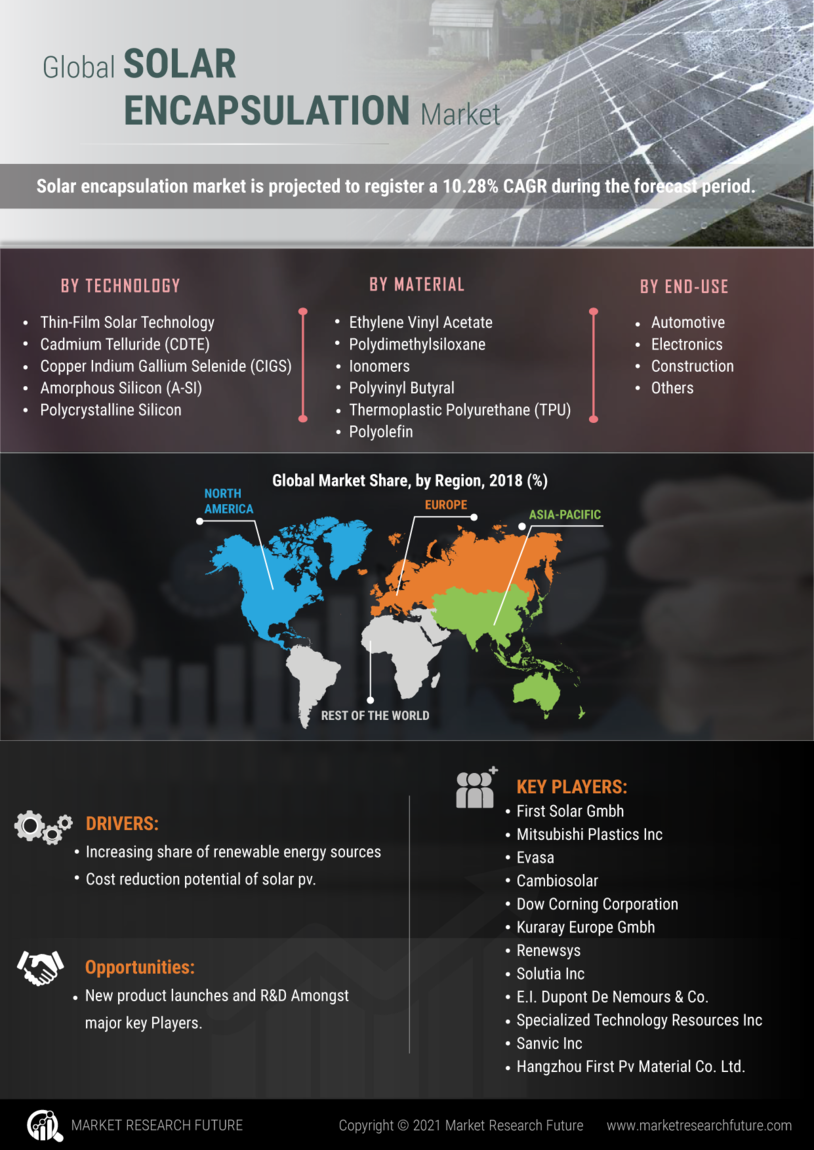
Technological advancements have played a vital role in shaping the solar encapsulation market. Materials such as Ethylene Vinyl Acetate (EVA), Polyolefin Elastomer (POE), and thermoplastic polyurethane are commonly used for encapsulation. Among these, EVA remains the most widely adopted due to its excellent transparency, flexibility, and cost-effectiveness. However, POE is gaining traction because of its superior moisture resistance and better performance in high-humidity environments. Continuous research and development efforts are leading to the creation of next-generation encapsulation materials that offer improved durability and efficiency.
Another major factor contributing to market growth is the rapid expansion of solar photovoltaic installations worldwide. Countries in Asia-Pacific, Europe, and North America are investing heavily in renewable energy infrastructure. China and India, for example, are among the leading markets for solar energy deployment. The increasing scale of solar farms and rooftop solar systems has created a strong demand for encapsulation materials that can enhance the lifespan and performance of solar panels.
The rising need for high-efficiency solar modules is also influencing market dynamics. Manufacturers are focusing on advanced module technologies such as bifacial solar panels and high-efficiency cell architectures. These advanced modules require improved encapsulation materials capable of maintaining transparency and stability under challenging environmental conditions. As a result, suppliers are developing innovative solutions that meet the evolving requirements of solar module manufacturers.
From a regional perspective, Asia-Pacific dominates the solar encapsulation market due to its strong solar manufacturing base and rapid expansion of renewable energy projects. Countries like China, Japan, South Korea, and India have established themselves as major hubs for solar panel production and deployment. Europe and North America are also experiencing steady growth as governments push for cleaner energy sources and reduced carbon emissions.
The competitive landscape of the market includes several global and regional players focusing on product innovation and strategic collaborations. Companies are investing in advanced production technologies to improve material performance and reduce manufacturing costs. Partnerships between solar module manufacturers and encapsulation material suppliers are becoming increasingly common as the industry seeks to develop more efficient and durable solar panels.
In the coming years, the solar encapsulation market is expected to witness substantial growth due to increasing solar power adoption, advancements in encapsulation technologies, and supportive government policies. The shift toward renewable energy and sustainability will continue to drive demand for high-quality encapsulation materials that ensure the long-term reliability of solar modules.
Solar Encapsulation Market Growth Driven by Global Solar Installations
https://www.marketresearchfuture.com/reports/solar-encapsulation-market-10421
The global renewable energy sector is expanding rapidly, and within it, the Solar Encapsulation Market Growth is gaining significant momentum. Solar encapsulation refers to the process of protecting photovoltaic (PV) cells with specialized materials that shield them from moisture, dust, and mechanical stress while maintaining high light transmission. As solar energy installations increase worldwide, the demand for high-performance encapsulation materials continues to rise, making this market an essential component of the solar power value chain.
Solar encapsulation materials are primarily used to enhance the durability and efficiency of photovoltaic modules. These materials are placed between the solar cells and protective layers, ensuring the cells remain stable and functional for long periods, often exceeding 20 to 25 years. The increasing adoption of solar power in residential, commercial, and utility-scale projects is a major driver of market expansion. Governments across many regions are promoting solar installations through subsidies, incentives, and renewable energy policies, which further fuels the demand for reliable encapsulation solutions.
Technological advancements have played a vital role in shaping the solar encapsulation market. Materials such as Ethylene Vinyl Acetate (EVA), Polyolefin Elastomer (POE), and thermoplastic polyurethane are commonly used for encapsulation. Among these, EVA remains the most widely adopted due to its excellent transparency, flexibility, and cost-effectiveness. However, POE is gaining traction because of its superior moisture resistance and better performance in high-humidity environments. Continuous research and development efforts are leading to the creation of next-generation encapsulation materials that offer improved durability and efficiency.
Another major factor contributing to market growth is the rapid expansion of solar photovoltaic installations worldwide. Countries in Asia-Pacific, Europe, and North America are investing heavily in renewable energy infrastructure. China and India, for example, are among the leading markets for solar energy deployment. The increasing scale of solar farms and rooftop solar systems has created a strong demand for encapsulation materials that can enhance the lifespan and performance of solar panels.
The rising need for high-efficiency solar modules is also influencing market dynamics. Manufacturers are focusing on advanced module technologies such as bifacial solar panels and high-efficiency cell architectures. These advanced modules require improved encapsulation materials capable of maintaining transparency and stability under challenging environmental conditions. As a result, suppliers are developing innovative solutions that meet the evolving requirements of solar module manufacturers.
From a regional perspective, Asia-Pacific dominates the solar encapsulation market due to its strong solar manufacturing base and rapid expansion of renewable energy projects. Countries like China, Japan, South Korea, and India have established themselves as major hubs for solar panel production and deployment. Europe and North America are also experiencing steady growth as governments push for cleaner energy sources and reduced carbon emissions.
The competitive landscape of the market includes several global and regional players focusing on product innovation and strategic collaborations. Companies are investing in advanced production technologies to improve material performance and reduce manufacturing costs. Partnerships between solar module manufacturers and encapsulation material suppliers are becoming increasingly common as the industry seeks to develop more efficient and durable solar panels.
In the coming years, the solar encapsulation market is expected to witness substantial growth due to increasing solar power adoption, advancements in encapsulation technologies, and supportive government policies. The shift toward renewable energy and sustainability will continue to drive demand for high-quality encapsulation materials that ensure the long-term reliability of solar modules.
👁️ 0 | 💰 Rs 0.00
⚡ First 24h Boost (+%)
• left
0 المشاركات
0 معاينة




 How To Earn On Freecave







 English
 French
 Spanish
 Portuguese
 Deutsch
 Turkish
 Dutch
Dutch
 Italiano
 Russian
 Romaian
 Portuguese (Brazil)
 Greek
Greek
